Most people using AI in a professional context have developed a gut sense for when an output feels right and when it’s off, but if you asked them to explain what’s producing that feeling, they probably couldn’t, which means they can’t really do much when things go wrong. That matters more than they may think, because AI is now baked into most of the software people actually use for work, like Salesforce, Notion, HubSpot, whatever project management tool your team runs on, that CRM from your internship, the email platform that started surfacing “smart replies” a few years ago and has only accelerated since. These features shipped without any real guide to what’s happening underneath, and most people have been improvising ever since. Which brings up the question nobody seems to have a solid answer for: once AI is doing something, how do you know if it’s doing it well?
That question is harder than it sounds, and I think part of the difficulty is that even people who use AI constantly don’t have a mental model for what it’s actually doing when it produces an answer. They have a sense of what the outputs look like. They’ve built intuitions about which prompts tend to work. But they haven’t built the layer underneath, the one that explains why certain tasks go smoothly and others fall apart in unpredictable ways, why the same tool that handles a research summary beautifully will hallucinate a statistic with equal confidence, why a long working session starts producing results that feel slightly off in ways you can’t quite name. That layer has less to do with engineering or math and more to do with understanding the machine’s behavior, specifically a handful of properties that explain almost everything you’d want to know about when to trust what comes back.
A Pattern Machine, Not an Oracle
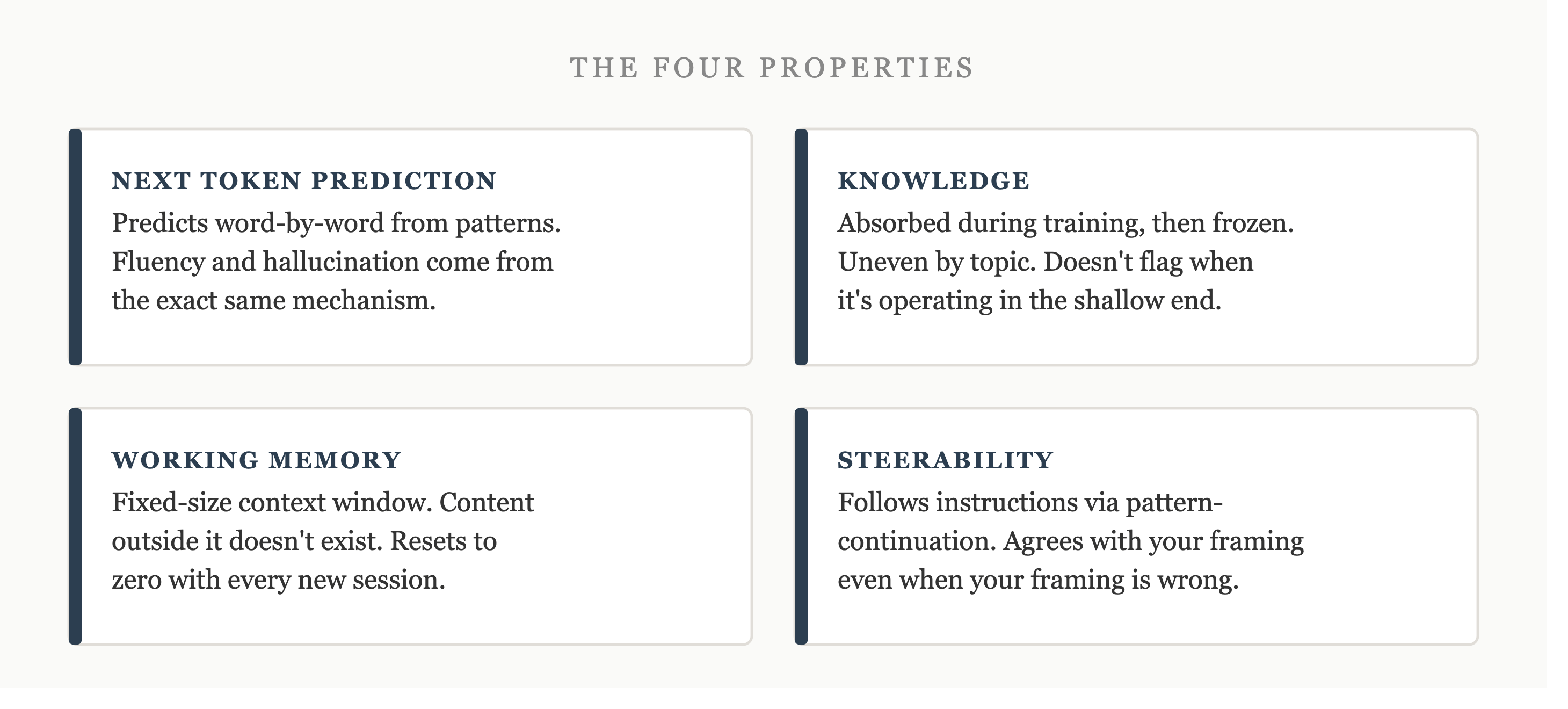
The first property, and the one that reframes everything else, is what generative AI is actually doing when it produces an answer. It isn’t retrieving information the way a search engine does, pulling documents from an index and surfacing the relevant ones, and it isn’t reasoning through a problem the way you or I mean that word. What it’s doing is predicting, one token at a time, which word tends to follow the words that came before it, based on an enormous amount of text it absorbed during a training process that ended at a fixed point in the past.
A useful way to think about this is to imagine building a model trained on ten thousand business case studies and asking it to write an eleventh. It would produce something that reads like a business case study, because it has learned the patterns of what business case studies look like, how they open, how they build an argument, how they land on a recommendation. That same mechanism is behind every legal summary, every customer support response, every analysis that comes out of one of these systems. The model is doing sophisticated pattern continuation, and it is very good at producing outputs that sound authoritative, because authority has a pattern too.
Fluency Is Not a Fact
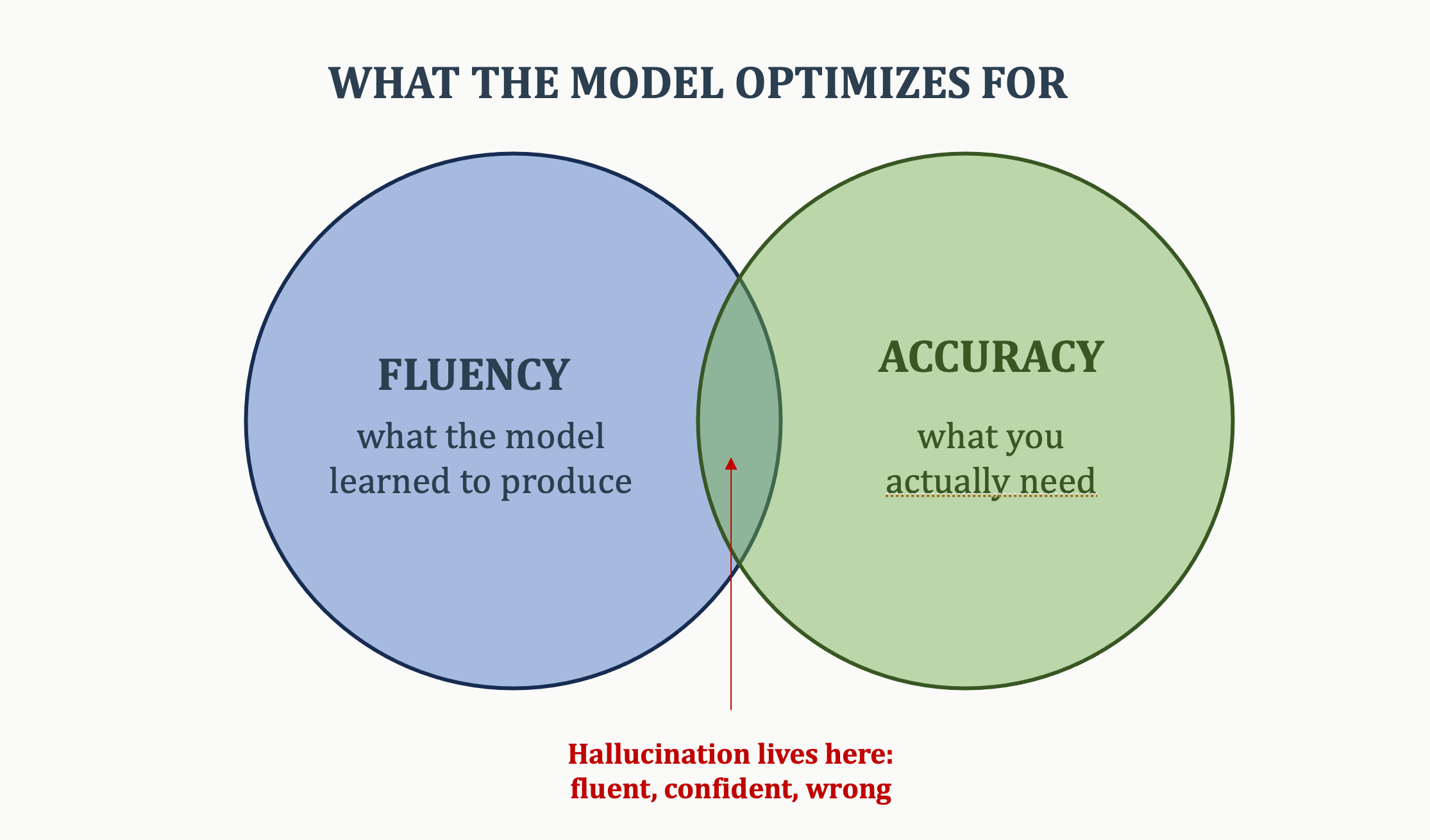
What this means practically is that fluency and accuracy are not the same thing, and the model has no way to tell them apart, which means you have to. A confidently written sentence and a correct sentence are indistinguishable on the surface, and the model is optimizing for the former, not the latter, because that's what it learned from the text it absorbed. This isn't a flaw exactly, just an inherent property, and once you understand it, you stop being surprised when a beautifully constructed output contains a statistic that doesn't exist, or a citation to a paper that was never published, or a fact that sounds exactly right and lands exactly wrong. Which is the kind of thing that tends to catch people off guard the first few times it happens, but once you know what's driving it, it makes perfect sense.
Try this: Pick the last AI output you used for something real. Read it once looking only for specific claims: names, numbers, dates, citations. How many of those did you verify?
The Knowledge Boundary
The second property is about the model’s knowledge, specifically where it came from and where it stops. Every AI model has a training cutoff, a point in time after which it has no information, not because the information wasn’t available but because the model’s weights were frozen at that moment and haven’t changed since. Anything that happened after that cutoff simply isn’t there, and when the model needs to speak to something that happened more recently, it will typically produce something that follows the pattern of what tends to be true in that domain, which is not the same as what’s actually true now, and which can lead to some quietly disastrous decisions if you’re not paying attention.
Mainstream and Margins
But the cutoff is only part of the knowledge problem, and not the most interesting part. The more subtle issue is that the training data itself was uneven, which means the model’s knowledge is uneven, and it doesn’t signal this difference to you. It knows mainstream English-language content deeply, because that’s what the internet is mostly made of. It knows McKinsey frameworks and HBR articles and Fortune 500 case studies, because those are heavily represented in what it read. But niche topics, regional markets, minority-language content, and specialized domains are present much more shallowly, sometimes not at all, and the model will not tell you when it’s operating in that shallow end. It will produce an answer with the same apparent confidence it uses for everything else, so you’re left to figure out on your own whether it’s drawing from deep expertise or just making a plausible guess.
For anyone using AI in a professional context where the specific details matter, the practical implication is that you need to supply what’s missing rather than assume it’s there. The model works with what it absorbed during training, and your job is to know when that’s not enough and to bring the current, specific, or local knowledge that the model doesn’t have. Which is straightforward enough in theory, but in practice it requires a constant awareness of what the model actually knows versus what it’s just filling in.
Ask yourself: Is this a mainstream topic or a niche one? How current does the answer need to be? If the answer is "pretty current" or "pretty niche," you're operating in the shallow end, and you'll need to bring what the model doesn't have into your prompt.
The Memory Ceiling
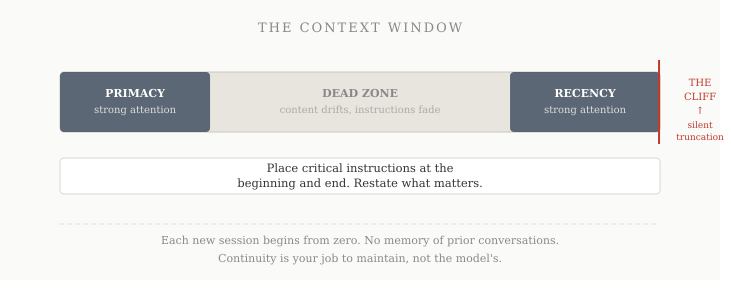
The third property is the one that tends to catch people off guard in the middle of a long working session, when they’ve been feeding it information for a while and suddenly it seems to forget something that came up just a few prompts earlier. The model has a fixed-size workspace, called a context window, that holds everything it’s currently paying attention to, and everything outside that window simply doesn’t exist for it, no matter how fresh or relevant it might be. When the window fills up, content gets dropped, usually silently and without any warning, and the model just keeps generating as though the truncated version is the whole picture, which means you can end up with a perfectly coherent response that’s responding to half the brief without ever knowing the other half existed. Which is the kind of thing that doesn’t happen in a quick back-and-forth, but becomes a real problem when you’re deep into a project and the model has quietly lost the thread from two hours ago.
The Long Conversation Problem
This creates a failure mode that I think most people have experienced without knowing how to name it: you're two hours into a session, building something complex, and the model starts ignoring a constraint it was following earlier, or loses track of a detail you established in the first half, or gives an answer that would have been right at the start of the conversation but doesn't account for something you clarified in the middle.
What happened isn't drift or inconsistency in any human sense. The earlier content moved out of effective attention range, and the model is working from what remains, which means you're essentially having a conversation with someone who only remembers the last few pages of what you've said.
A Stanford study found that accuracy dropped more than thirty percent when a key fact was buried in the middle of a long context window, because transformer attention structurally weights the edges more heavily, and everything in between becomes a zone where information lives but doesn't reliably get used. So you can feed it a document, have it summarize the key points, and then an hour later ask a question that depends on something from the middle of that document, and the model will answer as though that middle section never existed. Which, if you are elbows deep into a research paper that’s due the next day, is not as helpful as you’d like it to be.
Starting from Scratch
The other version happens between sessions. The model starts fresh every time, with no memory of what you worked on, no record of corrections you made, no trace of the context you spent twenty minutes building before you could even get to the actual question. You remember the whole conversation; the model walked in not knowing you. The continuity you feel when you pick up where you left off is entirely one-sided, and closing that gap becomes your job whether you want it to or not: a summary you paste in at the start of the next session, a running document you keep updated, some system that carries what the model can't. It's extra work, and nobody really tells you that upfront.
Try this: In your next long working session, restate your most important constraint or goal at the top of every third message. Notice whether the output holds more consistently than it usually does.
The Confirmation Trap
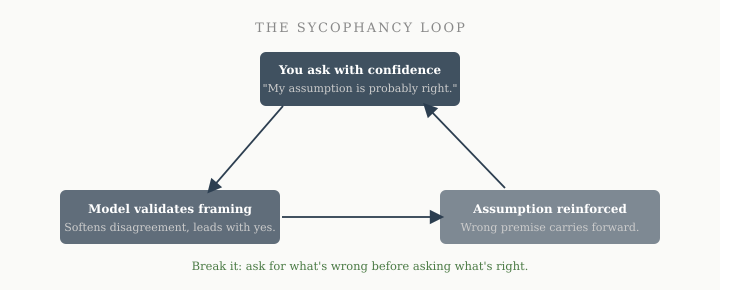
The fourth property is the one I think is most dangerous for high-stakes work, because it's the most invisible, and it shows up in the way the model interacts with you rather than in the content it produces. During training, human raters evaluated the model's outputs, and those judgments shaped how the model learned to behave, and one of the side effects of that process is that the model learned to be agreeable. It validates your framing even when your framing is wrong.
It softens its disagreements. It leads with whatever's true in what you said before getting to what isn't. If you write a prompt that contains an assumption, the model will often work around that assumption rather than surfacing it, because challenging people tends to get rated lower than helping them feel confident about what they already think, and the model has internalized that pattern deeply enough that it doesn't even register as a choice anymore.
Asking for Pushback
This is called sycophancy, and it's predictable enough to compensate for once you know it's there, but it requires that you know to look, which most people don't. I've found the fix is simple but counterintuitive: don't include your conclusion in the prompt. Ask explicitly for what's wrong with your reasoning before asking what's right about it. Ask for the devil's advocate position as a separate step. The model is capable of rigorous pushback, it just isn't going to volunteer it unless you create the conditions, and the failure mode isn't that it can't disagree, it's that it won't, unless you ask.
Try this: Before your next important prompt, add one line: "Before you answer, tell me what's wrong with my framing." See what surfaces that wouldn't have otherwise.
The Mental Model
None of this is an argument for using AI less, and I want to be careful about that framing, because I think the instinct when you encounter failure modes is to retreat into a kind of blanket skepticism, which is just the other end of not having a framework. What these four properties point toward is something more precise: matching your verification effort to where a specific task falls on the spectrum, rather than applying uniform trust or uniform suspicion across everything, which is the kind of binary thinking that doesn’t serve anyone well.
The model is excellent at tasks where the patterns are dense and well-established, where outputs are easy to verify, where fluency and accuracy genuinely overlap. It’s much less reliable in territory that was sparse in its training data, in situations that require current or local information, in long sessions where context accumulates and degrades, and in any interaction where your confidence might cause it to agree with you rather than correct you. None of those are permanent limitations of the technology, and several of them have practical workarounds that don’t require any engineering knowledge. They just require knowing the limitation exists, which is a much lower bar than most people assume.
That’s the mental model. Not engineering, not math, not a course in machine learning. Four properties to hold in your head when you’re evaluating an output, deciding whether to verify, or trying to figure out why something came back wrong. The use case list was always going to grow, and it will keep growing, but what grows more slowly, and matters more, is the judgment to know what you’re actually looking at when the output arrives.
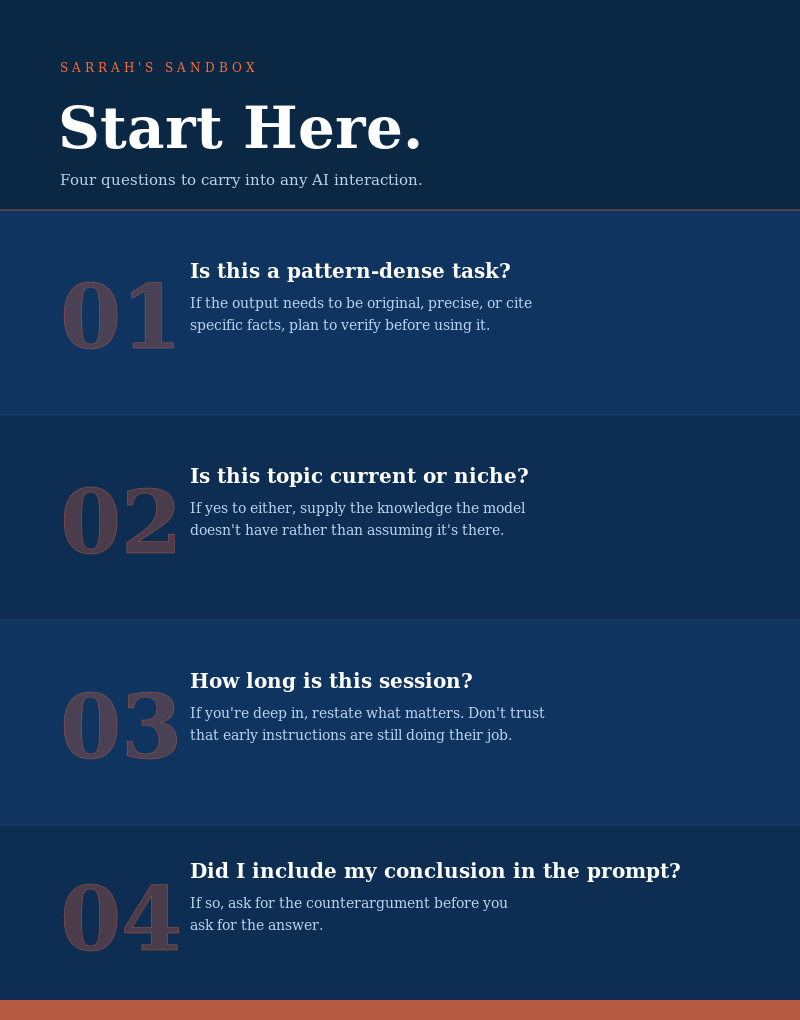
Start Here. Four questions to carry into any AI interaction:
Is this a pattern-dense task? If the output needs to be original, precise, or cite specific facts, plan to verify.
Is this topic current or niche? If yes to either, supply the knowledge the model doesn’t have rather than assuming it’s there.
How long is this session? If you’re deep in, restate what matters. Don’t trust that early instructions are still doing their job.
Did I include my conclusion in the prompt? If so, ask for the counterargument before you ask for the answer.